
|
|
|
Memory Distortion
an exclusive and revolutionary concept which radically pushes audio forward |
|
Lavardin Technologies designs and manufactures high end audio amplifiers using exclusive and revolutionary design concepts which radically reduce what we have named the "Memory distortion" of components.
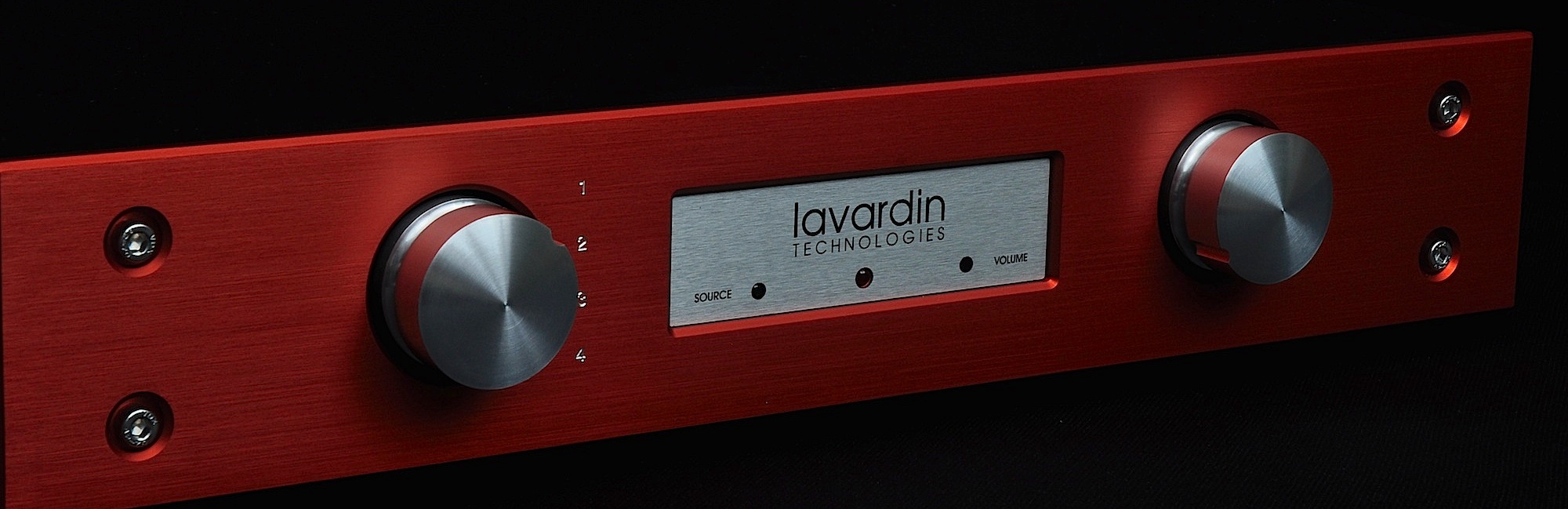
The memory distortion (1) of components is the greatest discovery in analog audio design over the last twenty years. It clearly demonstrates the reasons why a good valve amplifier can beat its solid state counterpart hands down for sheer musical enjoyment. Memory distortion is the property that is the dominant factor in causing solid state amplifiers to sound shrill and mechanical. Tube technology allows electrons to travel through a vacuum which leaves no storage or memory effect, but solid-state amplifiers use silicon components which keep a trace of current flow that has gone through. New electron flow is continuously affected by the pattern of the immediately preceding electron flow. As soon as the memory effect of these solid state circuits is reduced, all the improvements that transistor technology brings, such as high output power, accuracy, very low harmonic distortion and extended and linear frequency response, can be added to the most alive and silky musical rendition of the best single-ended monotriode designs. This may not sound very new: some manufacturers claim to combine valve smoothness with the muscle of solid state power by using hybrid designs. As a result, they only combine the memory distortion of solid state with the limited bandwidth and distortion capability of valves. This discovery at Lavardin Technologies demonstrates that the classic measurements made all over the world for the last decade are meaningless when considering the musical quality of an amplifier. In fact, when fixed frequency or fixed level test signals are used, it is not possible to detect remnant "memory" signals. Fixed frequency or fixed level signals may occur for less than 0.01% of the duration of any classical piece of music!! We do not believe that good sounding audio amplifiers should be designed to be perfect for 100% of the test time and only for 0.01% of the actual time they are reproducing music !!!  The Model IT integrated amplifier rated by many to be the FINEST AMPLIFIER EVER MADE, irrespective of price or technology, is the result of more than 8 years research on the memory effect of electronic components used in audio circuits designs.
Lavardin Technologies is proud to introduce this innovative concept to push audio radically forward. It breaks new ground in music reproduction. To hear a Lavardin once is a great experience: the music sounds natural, clear, fast and smooth, and never mechanical. This means that no other amplifier can be considered "the standard" any more.
|
TECHNICAL CORNER
What does memory distortion exactly mean? Memory distortion is a new concept in distortion process analysis. Usual concepts of distortion are based on a very simple distortion model which does not tally with the real behaviour of electronic circuits. In the classic theoretical model of distortion, distortion of a non selective circuit results from its band limitations for linear distortion and from its non-linear transfer function for non-linear distortion. This model is a good approximation for audio circuits. But for highest quality audio it is too simplistic. It results from a tonal approach to circuits for design and measurement. The tonal approach is very important and can be done accurately, but it ignores time; and musical flow is a key issue. That means that the classic approach to distortion measurements are valid only for time independent systems. However, the main difference between noise and music IS organisation in time. Audio circuits are not independent of time. A detailed analysis of their behaviour with non-stationary signals reveals many changes in their characteristics. The amplitude of these changes is generally low, and these changes remain hidden by stationary signals. This is the reason why they cannot be detected with classic (and tonal) measuring systems and are thus ignored by audio designers. The amplitude of these changes, however, is often great enough to be easily audible in high quality audio systems. That is the reason why listening tests with these systems do not tally with the usual measurements. These measurements are not able to characterise the behaviour of the circuits for musical signals in the time domain. They aim to measure THE transfer function, but they only measure ONE of the transfer functions - those which correspond to stationary signals. Most audio system are designed to be perfect for sine waves, but these are a very limited part of the total audio signal. These changes in circuit characteristics are linked to the signal itself, but not in real time, which leads to our new and exclusive concept of memory distortion. Memory distortion occurs each time that the dynamic behaviour of a system is different from its static behaviour. If there is no memory distortion, then static and dynamic behaviour are similar and classic (static) measurements are valid. This is the secret of "tube sound". We are proud at Lavardin Technologies to have full control over that which remains "The mystery of tube musicality" for previous audio designers. READ MORE HiFi News AES 100th Convention 1996 May Diapason |
|
(1) The memory distortion of components was discovered entirely by Lavardin Technologies engineers,
as are the procedures for measuring the very audible distortion which results from it. |
|
CONTACT US
Lavardin Technologies 42 rue de la Republique 37230 Fondettes France Tel +33 247.49.70.92 Email lavardin@cevl.com |
SUPPORT
NEWS FIND A DEALER FAQ TECHNOLOGIES ENTREPRISE LAVARDIN MUSIC |
PRODUCTS
AMPLIFIERS MODEL ISx MODEL ISx Ref MODEL ITx MODEL ITx 20 CABLES / HIFI K-rak |
TOP

|